An AI coding agent starts every session knowing nothing about my Mac. atlas-framework fixes that with 167 short markdown pages, one per repo, service and MCP server, rewritten by git hooks on every commit. The agent searches them with qmd instead of opening folders.
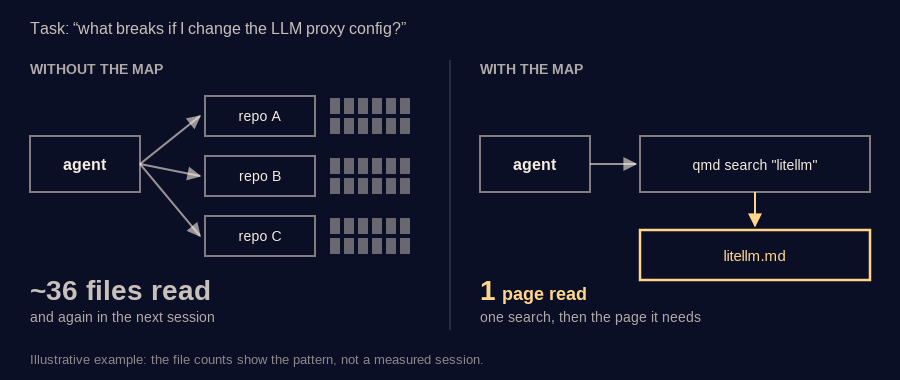
Why an agent needs a map it did not have to explore
An AI coding agent such as Claude Code or Codex starts every session knowing nothing about the machine it runs on. Opened in one repo, it cannot see that the LLM proxy it talks to is configured in another repo, that a launchd job runs from a third, or that a dependency was dropped last month for a license reason. It finds out by reading files, and every file it reads is paid for again in the next session.
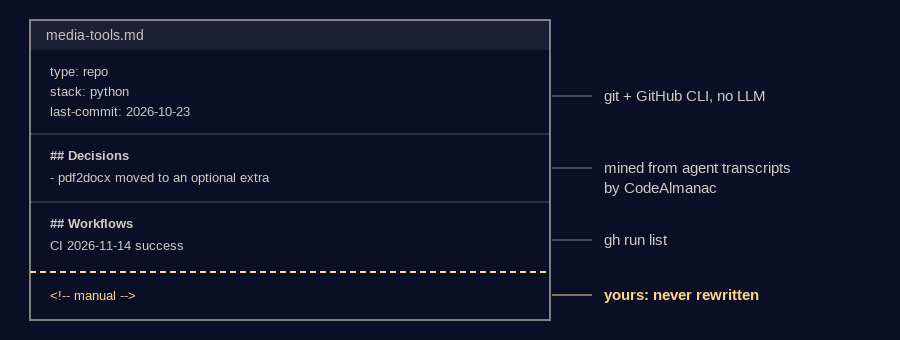
atlas answers those questions with one page per thing. This is the page it wrote for media-tools, one of my public repos, trimmed:
---
type: repo
title: media-tools
remote: github.com/jrodeiro5/media-tools
stack: python
last-commit: 2026-10-23
gitnexus-indexed: yes
generated: { by: process:repo-atlas, at: 2026-11-14T19:36:55Z }
---

## Decisions
- pdf2docx moved to an optional docx extra (AGPL PyMuPDF) — Decided 2026-09-20
- Local TTS uses Kokoro, not Chatterbox — autoregressive models run away

## Workflows
| workflow | last run   | status  | consecutive failures |
|----------|------------|---------|----------------------|
| CI       | 2026-11-14 | success | 0                    |
| Gitleaks | 2026-11-14 | success | 0                    |

<!-- manual -->
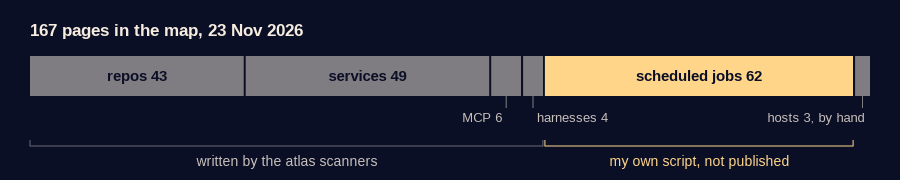
Nobody typed any of it. The frontmatter comes from git and the GitHub CLI, the decisions are mined from past agent transcripts by CodeAlmanac, and the workflow table comes from gh run list. Anything a human wants to add goes below the <!-- manual --> marker, and the next scan rewrites everything above it. On 23 November the bundle on my machine held 167 pages. The scanners in atlas-framework write the repo, service, MCP server and agent harness pages. Job pages come from a script of mine that I have not published, and host pages are written by hand.
A commit is the main trigger
Onboarding a repo sets git’s core.hooksPath to atlas’s own hooks folder. After that, every commit starts a chain of four steps in the background. atlas calls it the cascade. The commit returns at once.
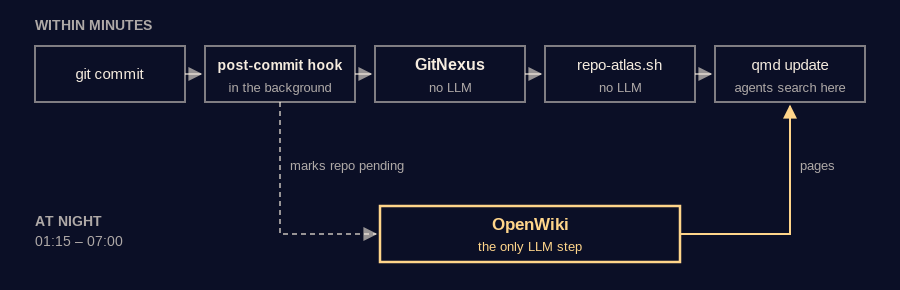
The pages catch up a few minutes later, except OpenWiki’s. OpenWiki is the only step that needs the local model, and I want that model free during the day, so the hook only marks the repo as pending. A nightly job, atlas-openwiki-nightly.sh, works through the pending repos from 01:15 and starts no new run after 07:00. A day of commits is one run, and atlas cascade <repo> still runs the whole chain on demand.
Three launchd jobs cover what commits cannot see: a periodic repo scan, a scan of the services macOS has loaded, and a local viewer for the bundle.
GitNexus builds a code graph, so an agent can ask what breaks if it changes a function instead of grepping for callers. OpenWiki writes narrative pages about how the repo works, and it is the only step that calls a model. repo-atlas.sh rewrites the entity page from git and GitHub with no model at all. qmd, a local search engine for markdown, re-indexes the result.
The generated files have to go somewhere, and that is where the cascade is most careful. In a repo whose remote is private, atlas commits the generated pages itself, with an Atlas-Cascade: trailer in the message so the hook recognizes its own commit and does not fire again. The commit uses an explicit list of paths, so anything I had staged in the meantime stays staged and out of the bot’s commit. In a public repo it commits nothing and leaves the diff for me, because a silent commit followed by my next push would publish model-written prose nobody read.
Private code never leaves the machine, even when the proxy is down
atlas-framework sends a repo to a model according to its visibility on GitHub, and a private repo only ever reaches a local model. Before OpenWiki runs, a short script asks gh whether the repo is public. If gh cannot confirm it, the repo counts as private. Both kinds go through the same local OpenAI-compatible proxy, LiteLLM by default, but they ask it for different models.
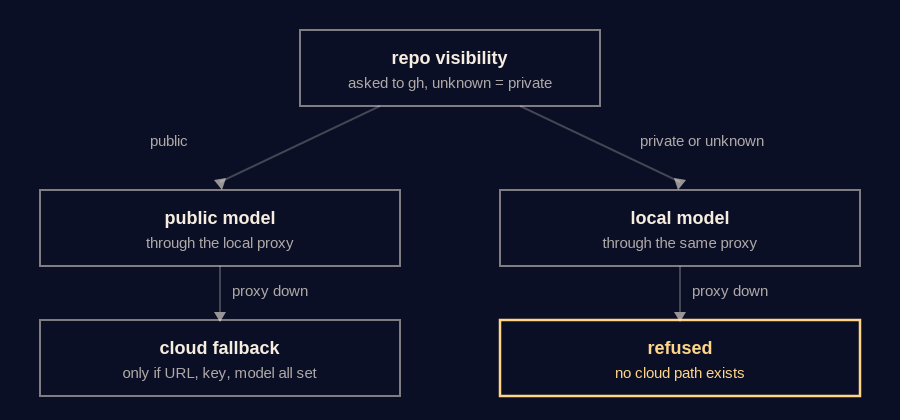
The branch worth looking at is the bottom right. When the proxy is down, a public repo may use a cloud endpoint if I have configured one, and a private repo gets nothing: the script refuses, and the page waits for the next commit. There is no setting that sends private code to the cloud, because the cheapest way to make that mistake impossible is to leave the code path out.
That rule only holds if the proxy agrees. LiteLLM can be configured with a global fallback that retries a failed request on another provider, and that would send private code out behind atlas’s back. The README tells you to keep the private model group local in the proxy config too. In August the private model on my machine was Ornith 1.5, a 35B mixture-of-experts model I compared against Qwen3.8 on the same Mac. It is now Inkling 2 Mini, after an eval of local models for an agent.
The cost is reading, so atlas cuts pages, not words
In atlas’s OpenWiki stage the model reads about 29 tokens for every token it writes. I measured it on 19 August 2026 from the LiteLLM spend logs: 62 OpenWiki calls read 2,020,977 prompt tokens and wrote 69,968 completion tokens, a ratio of 28.9 to 1. Completion was 3.3% of the total.
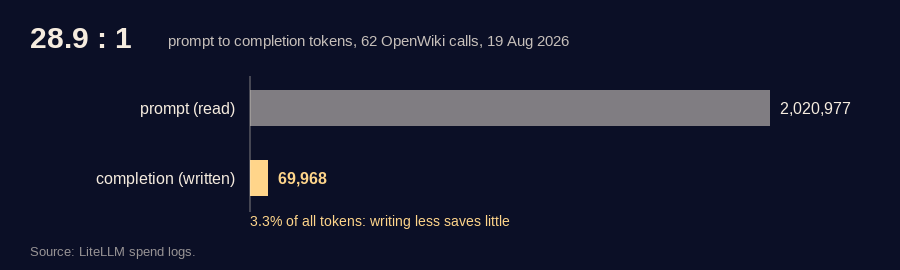
That number cancelled an experiment I was about to run. I wanted the model to write terser pages, and even a perfect result would have saved about 3%. The time goes the same way. Within one pass the prompt grew from 6,470 to 74,674 tokens, and a call with a 74,000-token prompt took 76 to 107 seconds on the local model while emitting about 300 tokens.
The same arithmetic applies to the agents reading the map, and it shaped the format. One entity per file, facts as lists, and a search index in front, so an agent reads the one page it needs instead of five. Generated output is never fed back in as source either: OpenWiki is told to skip its own pages, CodeAlmanac’s pages, the GitNexus index, lockfiles and .env files. Without that rule each pass would read the previous pass’s prose and the prompt would grow on every run.
Try it on one repo before wiring anything
atlas-framework installs from the repo on GitHub, and the first scan needs no model. These are the commands from the README:
git clone https://github.com/jrodeiro5/atlas-framework ~/dev/infra/atlas
ln -s ~/dev/infra/atlas/bin/atlas ~/.local/bin/atlas
atlas scan      # first scan, no LLM: one page per repo
atlas status
Read what the scan wrote before anything runs on its own. Then onboard a single repo with atlas onboard <repo>, make a commit, and watch its page change. atlas onboard <repo> --undo puts the repo’s hooks back as they were. The test suite runs every external tool as a stub in a fake home directory, with no network and no model, so test/run-tests.sh is safe to run before you trust it with your machine.
What is still rough
- macOS only, and opinionated: repos must live under
~/dev/<category>/<repo>and the wiki folder sits in the home directory, both hardcoded. - Bash 4 or later for the scanner, while macOS ships 3.2.
- Node 22 for OpenWiki, because its native SQLite module is built against one Node version and breaks on another.
- PolyForm Noncommercial is the GitNexus license, so commercial use needs its own license. The cascade skips that step when GitNexus is not installed.
- Nine repos on my machine still have no GitNexus index.
- One signal, an unclosed code fence, is all I trust to detect a page the model cut off halfway.
- No Nix out of the box. The three launchd jobs the framework ships as plists could be declared as
launchd.user.agentsin nix-darwin, and the README says how. Only my nightly OpenWiki job is declared that way, and the framework ships its script but no plist for it.
The same idea shows up at a different scale in my MeasureCamp Madrid 2026 talk, where the map is of analytics accounts instead of repos. In both cases an agent that can read the map before it acts makes fewer blind changes. Start with one repo: atlas scan, read what it wrote, then atlas onboard <repo>.
Keep reading
Agile Analysis with AI
A walk through AI tools, almost all of them free, for researching, analysing, documenting and presenting a data analysis from start to finish.

Choosing a local model for an AI agent on a 64 GB Mac
I tested seven local models as the brain of an AI agent on a Mac Studio with 64 GB. One passed the agent eval, and none could serve two requests at once.