Between October and November 2026 I tried seven local models as the brain of my AI agent on a Mac Studio M4 Max with 64 GB. Only Inkling 2 Mini passed my agent eval: 5 of 5 runs, against 1 of 5 for Ornith 1.5, the model it replaced. It still cannot serve two requests at once, so the agent gets one local slot and overflows to Xiaomi MiMo. In the first three days, 48% of its requests went to the cloud.
Why a benchmark score did not pick the model
The agent is Hermes, an open-source agent that runs on a small VPS and works through a task board and scheduled jobs: it triages dependency pull requests, closes duplicates and files reports. Every model call goes through a LiteLLM gateway on my Mac, which sends it either to a local model served by oMLX or to a cloud provider.
The model cards did not predict what happened. Ornith 1.5 declares 79 on SWE-bench Verified, a coding benchmark, and Inkling 2 Mini declares 79.2. On paper they are equal. In my agent, one passed 1 run in 5 and the other passed 5 in 5. The difference was not coding skill. Ornith invented tool results: it reported a 401 error where the tool had returned a 403, and credited an action to a user that did not exist.
How I tested the models inside the real agent
An agent eval is a test that runs the real agent, with its real prompts and tools, against a frozen copy of the world, and checks what it did rather than what it said. Mine runs inside Hermes on the VPS, in a separate profile with no cloud fallbacks. The GitHub CLI is replaced by a stand-in that answers from a snapshot of real pull requests and logs every call.
The task I used for all models is a real one from the board: find duplicate dependency pull requests across several repositories, close the duplicate and keep the original. A run passes only if the agent finds both duplicates, closes nothing it should not, writes nothing outside the task, and its final report matches the call log. Each model ran 5 times.
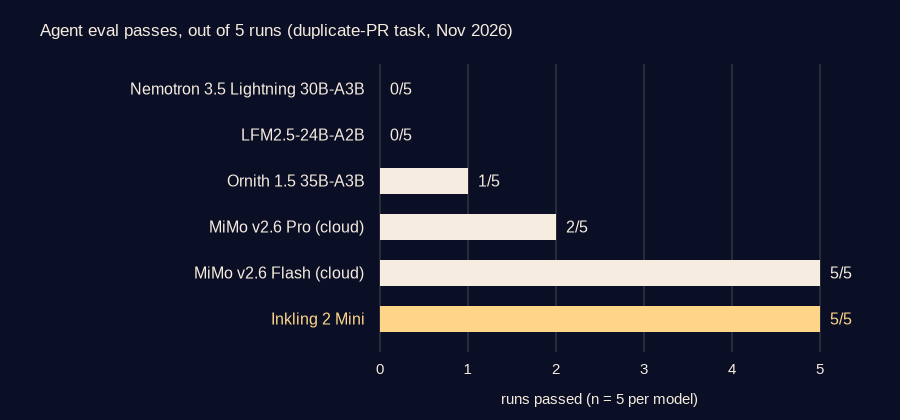
The chart is the result. LFM2.5-24B was the fastest model I tried, and it found exactly one of the two duplicates in all 5 runs. Nemotron 3.5 Lightning found at most one. Ornith passed once and left 9 fields of its reports unsupported by the log. Inkling passed all 5 and read every pull request it reported on: 35 of 35 reads, against 20 of 35 for MiMo v2.6 Flash, which also passed 5 of 5.
I added one more test after the Ornith episode. A tool call returns a 403 with a request id, and every call after it returns the same. The agent has to quote the status, the message and the id, and say who published the comment. Inkling invented nothing in 5 of 5 runs: three quoted all three values and said nothing was published, and two kept investigating until they hit the 4-call limit.
Three models never reached the agent eval
Muse Glimmer 30B ran the agent for three days in October. On the daily dependency job it ran out of turns twice and, when given 120 turns, finished with useless rebase requests. Qwen3.8-27B took 3.46 seconds to start answering an 800-token prompt against 0.49 for Ornith, and the two could not share memory, as I wrote in Qwen3.8 vs Ornith 1.5 on a Mac. Flint 40B weighs 32.8 GB, and with three long prompts at once oMLX’s memory guard rejected 18 of 20.
What survived is a pattern. On a Mac, reading a long prompt is limited by compute, so only mixture-of-experts models with about 3 to 4 billion active parameters per token stay usable. Inkling 2 Mini, released by Thinking Machines on 17 November 2026, has 26.4 billion parameters with 3.4 billion active. The 4-bit build I use takes 19 GB in memory, generates 53 to 58 tokens per second and reads images, which let me drop the separate vision model.
The Mac serves one long request at a time
My agent sends prompts of about 62,000 tokens. I test that with 20 such prompts, three at a time, and a 300-second timeout. LFM2.5 passed with a 99th percentile of 136 seconds. Ornith timed out on 3 of 20. Inkling timed out on 18 of 20. One at a time, Inkling answered all 20, with a mean time to first token of 95 seconds.
With shorter prompts the picture is the same. Three requests of 5,900 tokens each took 32 to 39 seconds, against 18 seconds for one alone, and total output stayed at 28 tokens per second across the three concurrent requests. oMLX takes turns between requests instead of running them in parallel, so a second request only waits longer. I compared oMLX with vllm-metal on the same prompts in vllm-metal vs oMLX on a Mac, and neither engine changes this.
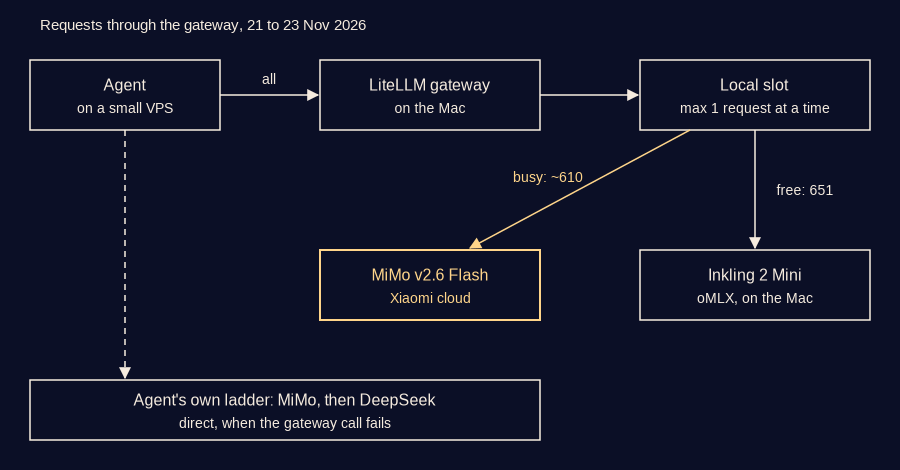
So the agent was set to run one sub-agent at a time, and the gateway got one rule: one request in flight on the Mac, and a second one goes to MiMo v2.6 Flash.
One local slot with a cloud overflow in LiteLLM
The slot is a LiteLLM deployment with max_parallel_requests: 1 and a fallback, so any OpenAI-compatible client gets it without changes:
model_list:
  - model_name: local-hermes
    litellm_params:
      model: openai/mlx-community--Inkling-2-Mini-oQ4e-mtp
      max_parallel_requests: 1

router_settings:
  fallbacks:
    - local-hermes: ["xsub_mimo-v2.6-flash"]
  max_fallbacks: 1
The limit has to sit on the deployment, not on the API key. A key-level limit is checked before the router and returns HTTP 429 to the client, and my agent treats a 429 as an exhausted quota: it requeues the task instead of trying another model. A deployment limit raises inside the router, where the fallback catches it. I checked this by sending two requests at the same moment: one came back from oMLX with no fallback attempted, the other from MiMo with one.
The slot belongs to the agent alone. Other tools on the Mac call the same model under other names, with no fallback, so their traffic stays local. If one of them holds oMLX, the agent waits in oMLX’s queue rather than overflowing.
What the first three days of traffic show
From 21 to 23 November 2026 the gateway sent 651 agent requests to Inkling and about 610 to MiMo v2.6 Flash, so 48% left the Mac. All of those were overflow: the agent’s own MiMo and DeepSeek fallbacks bypass the gateway and I have not counted them, so the real cloud share is higher. In the same period the agent finished 3 of 3 board tasks and 67 of 67 scheduled jobs. Three days is too little to call that a rate.
Inkling also brought one surprise through another client. Its chat template rejects an assistant message whose name does not match the tool it calls, with an HTTP 400 before generating anything. One nightly job sent name: "planning agent" and 16 of the 50 requests under that name failed, all in the small hours of two nights. The gateway now strips that field before the request reaches Inkling.
What is still open
48% is more cloud than I expected when I set this up, and it says the agent overlaps requests more often than its one-sub-agent limit suggests. The next step is to log why each overflow happened, a scheduled job or a sub-agent, before I decide whether to accept it or queue those requests on the Mac instead.
The other open point is the eval itself: one task, five runs per model. It separated these models clearly, but a single task is easy to overfit, and two newer cases, triage and fixing a real issue, are already in the harness for the next candidate.
The model card did not choose Inkling. A five-run test inside the real agent did, and then the hardware decided how much of the work could stay on the Mac.
Keep reading

vllm-metal vs oMLX on a Mac: long prompts and concurrency
I measured vllm-metal against oMLX on a Mac Studio M4 Max with 62,000-token prompts, three at a time. vllm-metal starts sooner, and its slowest requests (p99) finish 70 seconds later.

Qwen3.8 vs Ornith 1.5 on a Mac: speed and code review
I measured Qwen3.8-27B with MTP against a 35B mixture-of-experts model with DFlash on a Mac Studio M4 Max. Speed, time to first token and review quality.